Monthly Archives: October 2011
Siri & the British accent
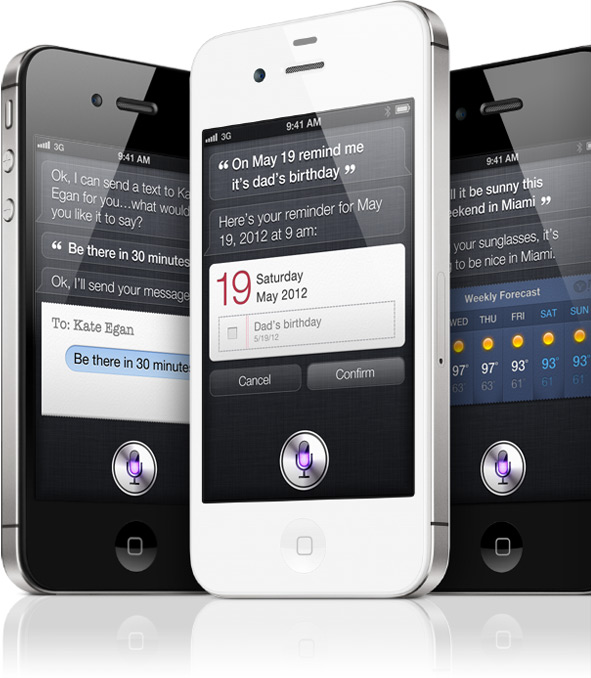 We got an iPhone 4S on Friday and was formally introduced to Siri, Apple’s latest voice-operated genie of sorts.
According to the Apple website, “Ask Siri to do things just by talking the way you talk. Siri understands what you say, knows what you mean, and even talks back.”
What they neglected to add was the “unless you’re British” addendum. Or so we initially thought.
In a conversation with friends Friday night, the subject of Pam Dawber came up (remember Pam Dawber from Mork & Mindy fame?) We were trying to remember the name of the old Pam Dawber TV show where she played the older sister? Anyone? Anyone?
Well, out came Siri to the rescue.
“Siri, who is Pam Dawber?” my husband asked her.
“Looking up Pam Dobah,” she finally responded.
“Pam Daaaaahburrrrr,” he had to repeat, with his worst impression of an American accent.
“Pam Dobah not in your contacts,” she said.
And this continued until we finally quit and looked it up via Google without Siri’s assistance.
(If you were wondering, the answer was My Sister Sam.)
We later discovered that there is a British English assistant that you can switch to – a male British butler type (like a posh Mr. Belvedere) with an ear for the differences between Dawber and Dober. He was able to locate Pam Dawber’s rap sheet without any trouble.
Now the only fly in the ointment is that the British Siri can’t look up businesses or locations. That can only be accomplished (for now) by American Siri.
So Brits had best start practicing the right way to say Los Angeles.
Oh, those pesky fine china drying woes!
 I have a love/hate relationship with tea towels. I love how they look and feel, but hate how semi-unabsorbant they are. Pretty? Yes. Functional? Well, they’d lose to a Bounty Quicker Picker-Upper every time.
But in researching the history of tea towels (oh, the things I do for you, dear reader), I’ve discovered that that is an unfair comparison to make. Tea towels were never intended to be used as a replacement kitchen towel to dry saucepans and colanders. Tea towels were created in 18th Century England as a towel to dry expensive tea service pieces of china. Hence, its name and the use of linen material so it wouldn’t scratch these fine pieces.
Fast forward to modern America and so many of us use tea towels as regular kitchen towels because, well, we have them around, we don’t exactly have fine
china and they are towels, aren’t they? I suspect we’ll continue to see an increase of tea towels in American homes as the tea towel industry continues to roll out sweet and sassy designs that make buying tea towels an easy sell. Even for those of us who have no business drying fine china.
In that spirit, check out some of these British-themed tea towels from ToDryFor.com.
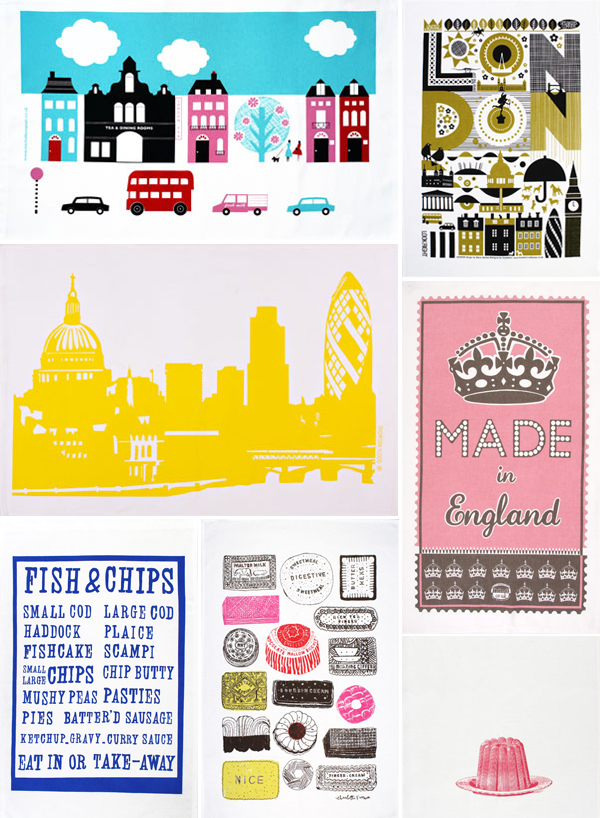
Shown above, starting at the top left and moving clockwise: London Calling, London, Made in England, Jelly, Family Favourites, Fish & Chips and City Skyline. All are available at ToDryFor.com, which delivers in the US.
Make mine a (British) pint
 I used to think that measurements were standard. An inch is an inch. A cup is a cup. No matter where you are in the world, right?
Well, apparently not.
Order a pint at the pub in the UK and you’ll get 20 ounces. Order a pint in the US and you’ll get a mere 16 ounces. Yes, a British pint is about 20% bigger than an American one.
This is usually the point when Brits can rightly beat their chests and guffaw at Americans with their tiny pints and their extra-cold lager and their “American football” played with all of that padding (sorry, that has nothing to do with beer. I just felt like throwing that in).
But here’s the science: Pints are units of measurements in something called US customary units as well as the imperial system, which is what the UK uses. And so, although they have the same name, they are two different animals.
Even more fascinating is this little tidbit, courtesy of Wikipedia: “A ‘pint’ of beer served in a tavern outside Great Britain and the United States may be a British pint, an American pint, or something different, depending on local laws and customs.”
The moral of this tale? If you must choose between a pint in the UK or the US, go with the British pint and choose some real ale, while you’re at it!
The Controller with Weight Issues
I’m always a little fascinated when American publishers take a perfectly good UK book and dumb it down for American audiences.
For example, the first Harry Potter book, Harry Potter and the Philosopher’s Stone, was renamed Harry Potter and the Sorcerer’s Stone in the US because the dumbledores at Scholastic didn’t think American kids would want to read a book with the word “philosopher” in the title. Sad.
Ditto with Thomas the Tank Engine which had to be renamed Thomas the Train in the US because heaven forbid, we make anything slightly complicated for American children. What did they think? We would confuse Thomas who looks, sounds and acts like a train with a car engine?
But some of these American publishers’ changes are just pure political correctness at their best. My favorite remains … this guy.

If you’re from the UK, you know him best as the Fat Controller. Because he is the train director, and, well, he’s fat. Simple. How much of a backstory do we need to give these characters? It’s not actually until you’re much deeper into the series that it’s revealed that his name is Sir Topham Hatt.
Now if you’re from the US, you know him only as Sir Topham Hatt. Not as The Fat Controller. (I imagine at some point they probably debated calling him The Horizontally Gifted Controller or the Metabolically Challenged Controller before settling on Topham Hatt.) The same is true for the character of The Thin Controller. He is only named Mr. Percival in the US. (Not the Horizontally Challenged Controller.)
And that’s fine. They can call them whatever they want. But in my house? We’re reading the British versions.
Big shot

Yesterday, I had to take a tuberculosis skin test for work. A truly foreign concept for Brits, who receive a Bacillus Calmette-Guérin (better known as a BCG) vaccine in childhood and then are done with it.
Now most Americans have no idea that a vaccine exists for tuberculosis. I know I didn’t. I thought it was a joke when I studied in Scotland and found that everyone had this weird pox scar on their upper arm, a scar left over from the vaccine. Apparently the shot hurts like hell when you get it. I mean, pox-scarring, hold-on-don’t-pass-out pain. But it means immunity for life. Well, almost.
Apparently, the efficacy of the shot actually depends on your geography. Whaaaa? Yes, apparently UK trials have shown a 60-80% protective rate, but the closer you get to the equator, the less effective the shot. And there are scientific reasons for that, but I won’t bore you.
What I will say is that it does sort of explain why American doctors, who are typically vaccine-crazy, don’t give out the BCG vaccine. Only these TB skin tests, which can be given on a regular basis to check for exposure to TB.
We have dodged the big needle, my friends. Sometimes, being American has its privileges.
Singing with an accent
 On Sunday morning, I stopped into a Starbucks for my morning coffee and ended up in line behind a middle-aged couple, who were trying to decide whether to buy a copy of Hugh Laurie’s latest blues CD on display.
After a moment of consideration, the barista said, “Have you heard anything from his album? It’s really very good. It has some great piano and he has a good voice. You can’t even tell that he has an accent.”
One moment later, the man handed it to the barista and said, “I’ll take it.”
This whole interaction was fascinating to me for a couple of reasons.
1) I have never seen anyone buy a CD at Starbucks. I’ve never even seen anyone ever pick up a CD featured at Starbucks to take a closer look. Have you? And for this man to purchase this CD, without ever hearing any of it? Truly a leap of faith.
2) I am fascinated that the barista felt compelled to say that Hugh Laurie sings without an accent. It’s a strange selling point. Is music more or less likable when sung with or without an accent? Does anyone really care?
I’ll admit that the ability to sing without an accent is an unusual talent. I’m not quite sure how it works. But I can only imagine it’s like the natural inclination I have when I hear a country song and feel the need to sing to it with the worst hillbilly accent that I can muster. Maybe that’s how Hugh Laurie feels when he sings the blues. Sometimes songs just sound better or feel better with an accent (even if it’s not your own).
But I’m sure part of this homogeny of accent-less music these days is a calculated move by studio execs to make music more palatable to an American audience.
And to that, I say calculated commercialism, be damned. I like hearing an accent in my music. I like the way the Proclaimers sound when they go all Scottish on “500 Miles”. I like hearing Herman’s Hermits singing about how Mrs. Brown has a lovely dah’er. And I like hearing the Arctic Monkeys’ Fake Tales of San Francisco, when I can already tell they’re not from there.
Am I the only one? How do you feel about hearing accents in music?
The Californian’s definition of cold
This week, we’ve had terrible rain in California. And by terrible, I mean about 3/4 of an inch of rain in a day. Highs in the 60s Fahrenheit (around 17 degrees Celsius). Nothing crazy. Certainly nothing to warrant the medley of parkas and ski caps that I’m already seeing around here.
Last week I blogged about how Brits put on their summer’s best when the weather reaches a balmy 70 degrees. By the same token, Californians are guilty of dressing like New Englanders the moment temps dip into the low 60s.
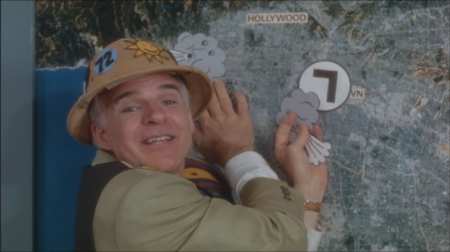
One of my favorite parts of LA Story is an LA weather report from Steve Martin’s character Harris Telemacher:
Harris: And when the weather dropped down to 58 degrees this weekend, how did you cope?
Man on the Street: I went to make sure all the windows were shut.
Harris: And, what about your pets? Were they outside? What happened?
Man on the Street: Well, the cats were out till around ten. But it got a little too cold for them and they came in.
Harris: The cats were out till around ten. But it got a little too cold for them and they came in! Well, that’s how LA coped with that surprise low of 58 degrees that turned the weekend into a real weenie shrinker!
And on that note, may your weekend be warm and rain-free! Have a good one!
The Pluralization of Lego

This weekend Lego KidsFest will be held in Raleigh, North Carolina. You can bet there will be a lot of talk about Legos there.
This weekend, we’ve been invited to a friend’s son’s 6th birthday party and when I asked my friend what her son might like for a toy, she told me that he was “really into Legos.”
Legos.
Yes, she pluralized it. It might just be the eighth deadly sin in Britain.
I think I speak for all Americans – every single, red-blooded one – when I say that we all pluralize Lego. We can’t help ourselves. We know it’s a brand name. We know you need more than one block to properly play Lego. So it just makes sense to us to add that s.
And to be fair, we don’t just do it with Lego. We do it with Barbie and with G.I. Joe and My Little Pony. We add s’s to every one of them.
But for some reason, the Lego thing in Britain is a thing. It’s always referred to as Lego, which is actually the correct pluralization of Lego. It doesn’t matter if you’ve got a handful of them or a giant British army of them.
It’s like the way moose is the plural of moose. Or sheep is the plural of sheep. Or deer is the plural of deer. Americans just never got the memo.
Do you say Lego or Legos?
American vs. British news theme songs
I’m sorry to say I’m late to the game in discovering the awesomeness that is British comedian/actor/musician Bill Bailey. But thanks to Brian Braiker, I’ve discovered his hilarious look at the differences between American and British news themes.
Toting London

Until the first GPS-powered tote bag has been invented, I’m happy with this alternative: a Maptote brand cotton grocery bag, bearing a map of London.
It’s available in white/lime green or black/orange (very Halloween, people!) and is made in Brooklyn, New York.
Just imagine how British your groceries will look in a bag like this …


 BRITRISH.COM