Blog Archives
Ode to the Oxford comma
Let’s take a moment to give some love to the Oxford comma, which was traditionally used by printers, readers and editors at Oxford University Press.
Although the University of Oxford has officially dropped the Oxford comma in their style guide, there is still a case for keeping it around.
Below are two illustrative examples:
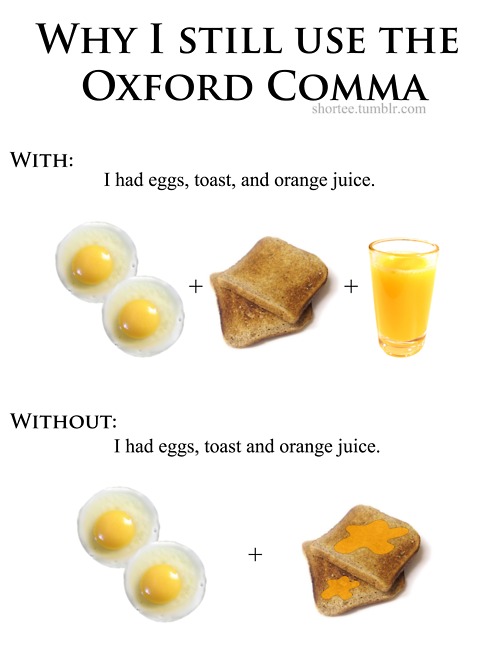
and …

Totes Amaze
Sometimes an expression just comes along that grabs me. For awhile it was “bajiggety,” as in out of sorts, confused, flustered, upset. It was used in “The Sweetest Thing” with Christina Applegate and Cameron Diaz and I latched on. It is a stellar phrase.

But it’s been surpassed by “totes amaze,” as in totally amazing. The Brits are using it. It’s whimsical, youthful, and little stupid. It’s the two words that British singer Lily Allen tweeted right after having her baby.
Totes amaze. Coming soon to the U.S.
The Pluralization of Lego

This weekend Lego KidsFest will be held in Raleigh, North Carolina. You can bet there will be a lot of talk about Legos there.
This weekend, we’ve been invited to a friend’s son’s 6th birthday party and when I asked my friend what her son might like for a toy, she told me that he was “really into Legos.”
Legos.
Yes, she pluralized it. It might just be the eighth deadly sin in Britain.
I think I speak for all Americans – every single, red-blooded one – when I say that we all pluralize Lego. We can’t help ourselves. We know it’s a brand name. We know you need more than one block to properly play Lego. So it just makes sense to us to add that s.
And to be fair, we don’t just do it with Lego. We do it with Barbie and with G.I. Joe and My Little Pony. We add s’s to every one of them.
But for some reason, the Lego thing in Britain is a thing. It’s always referred to as Lego, which is actually the correct pluralization of Lego. It doesn’t matter if you’ve got a handful of them or a giant British army of them.
It’s like the way moose is the plural of moose. Or sheep is the plural of sheep. Or deer is the plural of deer. Americans just never got the memo.
Do you say Lego or Legos?
Divided by a common language?
My mother in law sent me an amusing article last week that I wanted to share here: “Divided by a Common Language – A Lighthearted Look at Linguistic Differences Across the Atlantic.”
Perhaps my favorite example is the fact that Brits call erasers “rubbers.” I died laughing the first time I heard that one, particularly since British parents are so insistent about packing rubbers in their children’s pencil cases before they head to school.
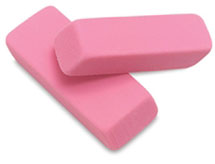
British rubbers - not to be confused with American rubbers.
It’s almost as funny as the British phrase “Keep your pecker up,” which means of all things, “Cheer up!” A friend of mine’s father worked with a Brit a few years back and still recalls how jaws dropped when he would naively use the phrase in the office.
A special thank you to Sue for sending this my way.
The Britishism Invasion
So, we might be to blame for the fact that Americanisms like “my bad” and “you do the math” has entered the British lexicon, but Slate writer Ben Yagoda has been chronicling the Britspeak, or what he has coined Britishisms, that have been showing up on our sandy shores.
Here are just a few examples:
Advert (instead of advertisement or ad), bespoke, bits (instead of parts), brilliant, called (instead of named), chat show, chat up, cheers, a coffee, cookery, DIY, early days, fishmonger, full stop (instead of period, as in the punctuation mark), ginger (a red-haired person), gobsmacked, had got (instead of gotten), Hoover (as a verb), in future, keen on, kerfuffle, mobile (as in mobile phone), on holiday, one-off, posh, presenter (a television host), queue, sell-by date, shite, short-listed, snog (passionately kiss), sort out, spot on, starter (instead of appetizer), straight away, take a decision, top up, twee, wait for it, wanker, and whilst.
And you can read more in this week’s Slate article.
A special thanks to @RichAppy who tweeted me this story.
Lohs Angeleez
Last night, we watched the series premiere of The X-Factor, which spotlighted auditions in Los Angeles.
Or should I say Lohs Angeleez? Because that’s what host Steve Jones, as well as British judges Simon Cowell and Cheryl Cole were calling it repeatedly. LohsAngeleezLohsAngeleezLohsAngeleez.

An aerial view of downtown Lohs Angeleez. Photo credit: Marshall Astor.
But why? What’s wrong with Lahs Anjuhles? Or at least the original Spanish Lohs Annhelles?
I don’t think it’s a turn of phrase that is difficult to say with a British accent so I have to wonder … How do these sorts of national mispronunciations get started? Is there a British pronunciation handbook somewhere that decides these sorts of things? Is it written by the Queen? And can I buy it on Amazon?
You say tomato, I say tomahto
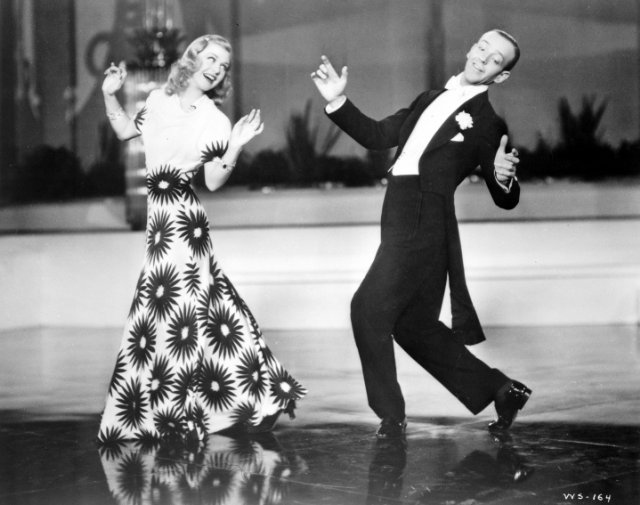
In 1937, George and Ira Gershwin’s song “Let’s Call the Whole Thing Off” was featured in a film called “Shall We Dance” with Fred Astaire and Ginger Rogers. It was apparently part of a dance number done on roller skates.
I haven’t seen the movie but I love the song. Correction – we love the song and over the years, Matthew and I have come up with quite a medley of verses as we have discovered the slight differences in pronunciation between British English and American English. Our song goes something like this …
You say scheduled, I say sheduled,
You say oREGano, I say oreGAHno,
Scheduled, sheduled
oREGano, oreGAHno,
Let’s call the whole thing off.
You say aluminum, I say aluminium,
You say mom, I say mum,
Aluminum, aluminium,
Mom, mum,
Let’s call the whole thing off.
You say wahter, I say wohtah,
You say BAYsil, I say BAAAzil,
Wahter, wohtah,
BAYsil, BAAAzil,
Let’s call the whole thing off.
You say garAHj, I say gare-edge,
You say airplane, I say aeroplane,
GarAHj, GARE-edge
Airplane, aeroplane,
Let’s call the whole thing off.
We can sing like this for quite a while. Can you add a verse?
The cute-ification of things

Aww ... look at the little bitty pressie!
Brits like to cute-ify their words. Cute-ify, you ask? Well, you know, make cuter. Cuten them up. I know, I know, “cute” is a distinctly American word. But it’s the only word that seems appropriate for the random act of adding an “i-e” to words – not in the presence of babies or small children but in everyday life amongst grown-ups. Americans don’t do this. If we’re talking about a present, we call it a present. We don’t call it a “pressie.”
Here are some other examples:
Cardigan = Cardi
Lipstick = Lippie
Chocolate = Choccie (pronounced chock-ie)
Biscuit = Biccie (pronounced bick-ie)
Sweets = Sweetie
Postman = Postie
Swimming costume = Cozzie (I just learned this one, thanks to Tori and Marti – hey, even you both cute-ified your names …)
And there are dozens more like this. Can you think of any others?


 BRITRISH.COM