Category Archives: Culture
Happy Thanksgiving!

Today I’m thankful that the Pilgrims fled England, landed here, ate with the natives and came up with what has become the greatest holiday that we as Americans have.
That’s right. I’d choose Thanksgiving over Christmas, Easter, Fourth of July and Halloween any day. Think about it – It’s the one holiday that unites us regardless of one’s race, religion, age, orientation, affiliation … Anyone can celebrate it. You don’t even have to be American. It hasn’t been commercialized like everything else in America. You don’t give gifts or cards. You just prepare a really good meal. Best of all, the focus is on being thankful for what you have and spending time with the people that you love.
On that note, I’ll see you back here on Monday!
Unleashing your inner Iron Lady

Meryl Streep plays Margaret Thatcher in "Iron Lady." Love the 'do.
Never deny the power of big hair.
Margaret Thatcher’s sizable bouffant is reported to be all over the runways of Marc Jacobs and Chanel and now, with the release of “Iron Lady” this winter, this big hair trend is expected to be … well, even bigger.
Intrigued? Check out celebrity hairdresser Marc Woolley’s step-by-step instructions for creating this large-and-in-charge look.
I’m pretty sure that global domination requires an iron fist, large heated rollers and a paddle brush.
Boogers, bogies, and the bogey man
 I’m taking a moment to clarify since this is a confusing matter:
Boogers [boog-er] : a piece of dried mucus in or from the nose.
Bogies [boh-gee] : British. a piece of dried mucus in or from the nose.
Bogey man [boog-ee-man, boh-gee-, boo-] : An imaginary evil character of supernatural powers, who may or may not have boogers or bogies in his nose, especially a mythical hobgoblin supposed to carry off naughty children, who may or may not have boogers or bogies in their noses.
Questions? Bueller? Bueller?
Bum envy
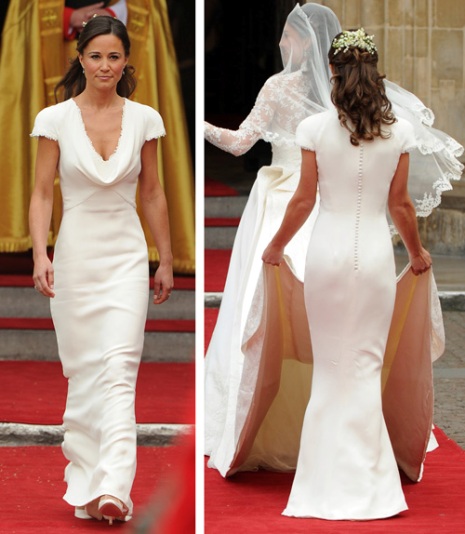
Everyone wants to be Pippa Middleton. Or at the very least they want her bum (translation: bottom).
Last month, British retailer Debenhams launched a line of derriere enhancing padded underpants and they’ve been flying off the shelves. This week, Debenhams released sales figures indicating that they’re outselling their non-padded counterparts by 148 percent.
Brits are actually paying for more junk in their trunk. Who would’ve thought? That’s Pippa power, folks. Don’t doubt her sphere of influence.
Why else would the Huffington Post this week dedicate an article, not to her recent breakup with longtime boyfriend Alex Loudon (or anything else), but on her bold decision to wear leggings as pants? (On that note, let’s all hope that is a trend that she doesn’t help start…).
Gis a poppy

Royal British Legion's paper poppy, part of its Poppy Appeal
In the U.K., you’ll find poppy pins worn on people’s lapels in the days (and weeks) surrounding Remembrance Day (otherwise known as Veterans Day in the U.S.). They’re everywhere – on the young and on the old, on the streets, in offices, shopping centers, parks, restaurants. Everywhere.
Such is not the case in the U.S., where it’s uncommon to see poppy pins, particularly on Nov. 11.
Even on the U.S. Department of Veteran Affairs website, the FAQs page on Veterans Day reads: The wearing of poppies in honor of America’s war dead is traditionally done on Memorial Day, not Veterans Day. I would argue it’s also rare to see Americans wearing poppies on Memorial Day.
After spending some time looking online for a U.S. source selling poppy pins and coming up with nothing, it became clear why I’m not seeing these poppy pins anywhere. Sad. Gis a poppy. Please. Our country needs them!
On a side note, the U.S. is where the poppy tradition originated, at least according to Wikipedia so it must be true. Poppies were first used in the U.S. in 1920 to commemorate soldiers who died in World War I.
Celebrating 50 years of Private Eye
 Private Eye Magazine celebrates its 50th anniversary this year and the Victoria and Albert Museum in London has dedicated a gallery to commemorate this very British phenomenon.
If you’ve never read Private Eye, check it out here. It’s British satire at its best, along with politics, humor, cartoons and real investigative journalism. I think of it as a more seasoned, more stately Mad Magazine.
Private Eye: The First 50 Years runs through January 8, 2012 at the Victoria and Albert Museum. Admission is free.
Remembering Bonfire Night
I’ll never forget my first Bonfire Night in the UK. Fireworks. Beer. Heavy rain. A big bonfire burning the effigy of a guy. All in remembrance of one Guy Fawkes.
Who? This guy.

George Cruikshank's illustration of Guy Fawkes, published in William Harrison Ainsworth's 1840 novel. Thank you, Wikipedia.
Guy Fawkes is best known as the brains behind the Gunpowder Plot, a failed plot by a small group of English Catholics to assassinate the Protestant King James, by blowing up Parliament with 36 barrels of gunpowder. The king was tipped off, foiling their plan on Nov. 5, 1605 and Fawkes was tortured and executed. He should not to be confused with this guy:

Yes, I did mistakenly think that it was Grey Fox Night that we were celebrating. Not so far fetched – we do have a Groundhog Day, now don’t we?
For me the 5th of November will always be Grey Fox Night.
New money
Today the Bank of England has begun circulation of a brand spanking new £50 banknote. Behold!

I’ve previously discussed the beauty of British money. The latest banknote features the portraits of Matthew Boulton and James Watt, inventors of the steam engine, which later led to the manufacturing of coins that were difficult to counterfeit.
Note that this is the first time that two portraits have appeared side by side on the back of a Bank of England banknote. Real history in the making and fodder for future Jeopardy episodes.
Even more impressive is the fancy stuff. Since I’m not in the inner circle to get my mitts on one of the first £50 banknotes, I’ll leave the description to the BBC:
“The new version of the £50 banknote has a thread woven into the paper, rather than printed on it.
There are images on the thread of a £ symbol and the number 50 which move up and down when the banknote is tilted from side to side.
When the note is tilted up and down, the images move from side to side and the symbols switch.”
What??!! Numbers moving up and down?! Images moving side to side?! Symbols switching?! Is this currency or something courtesy of David Blane?! Why can’t the US put this kind of thing together? Oh US Treasury, I know you’ve got a lot on your plate, but please step up your game.
Happy Halloween!
I’m a fan of many Halloween time-tested traditions (carving pumpkins, fancy dress, pumpkin beer, etc.) but my absolute favorite remains trick-or-treating, which is still alive and (very!) well in the US.

Leave it to Americans to celebrate what is basically knocking on strangers’ doors and begging for candy, while dressed as Harry Potter or Spider-Man. It’s a veritable street party with roving bands of kids dressed up, moving house to house in search of the best treats.
There’s something simple and wholesome about it.
Yes, I still get trick-or-treaters who haven’t been kids for quite some time and yes, last year, some of these aforementioned trick-or-treaters didn’t even bother to wear a costume. But never mind! In the spirit of the holiday, I give generously and so do my neighbors.
So much so that we have enough candy to get us through most of November. Isn’t that what it’s all about?
Red light, green light (oh, and amber light)
In addition to baking up a storm this weekend, I also completed online traffic school.
(You may remember that I was smacked down with not one, but two red light traffic camera tickets a couple of months ago – a proverbial embarrassment of riches after years of a near-perfect driving record.)
Well, this weekend I was eyeballs-deep in the rules of the road. Among other things, I refamiliarized myself with the red, yellow and green light. Or rather, the red, amber and green light, if you’re a Brit.
Red, amber and green? Yes! Is there anything more poetic than to call your basic yellow light “amber”? And why stop there? They should go with crimson, amber and moss? Or candy apple, amber and emerald? Why not?!
And that’s not the only difference between UK and US traffic lights.
* American lights go red to green to yellow, then back to red.

* British lights are more complex. They go red to red and amber at the same time, to green to amber, then back to red again.

I have heard that the US used to have this kind of sequence back in the 1950s and that you can still spot this in some parts of rural America but I have yet to see a yellow light follow a green light. Have you?


 BRITRISH.COM