Category Archives: British
Divided by a common language?
My mother in law sent me an amusing article last week that I wanted to share here: “Divided by a Common Language – A Lighthearted Look at Linguistic Differences Across the Atlantic.”
Perhaps my favorite example is the fact that Brits call erasers “rubbers.” I died laughing the first time I heard that one, particularly since British parents are so insistent about packing rubbers in their children’s pencil cases before they head to school.
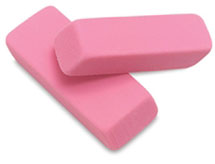
British rubbers - not to be confused with American rubbers.
It’s almost as funny as the British phrase “Keep your pecker up,” which means of all things, “Cheer up!” A friend of mine’s father worked with a Brit a few years back and still recalls how jaws dropped when he would naively use the phrase in the office.
A special thank you to Sue for sending this my way.
Time Out’s Eating & Drinking Awards
 I’ve said it before and I’ll say it again – London is home to some of the best restaurants in the world and this week Time Out is highlighting the best of the bunch in their 2011 Eating & Drinking Awards!
Even better, they’ve posted all of their picks on their website.
This year’s categories include best new restaurant, best sushi bar, best new bar and best new cheap eats.
I’ve already bookmarked it for my next trip to the Big Smoke.
A fool-proof béchamel sauce
Béchamel sauce and I have a love-hate relationship. I mean, I love it. I love the marriage of melted butter, flour and milk, whisked quickly over heat. I love it in macaroni and cheese and in an authentic lasagne (that is, one without ricotta. Sorry, I don’t like ricotta in my lasagne, which is sadly how most Americans make it). And I love the jaunty accent in béchamel. It might as well have a beret and smoke gauloises.
But I’d say 95% of my attempts at making béchamel sauce have failed, giving me an end result of a frustratingly thin sauce, when the goal is a thick, unctuous, creamy goo.
Last night, on the spur of the moment and with a head of cauliflower in the fridge that needed to be eaten pronto, I whipped up a cauliflower cheese. For the uninitiated, cauliflower cheese is a fantastic British recipe, particular for vegetarians in your life. It’s great when paired with a roast rib of beef, but also delicious on its own. The gist is not unlike a proper homemade macaroni cheese, except we replace the macaroni for cauliflower.
And it does involve making béchamel sauce. I tried a Nigella Lawson recipe from her Feast cookbook and voila!
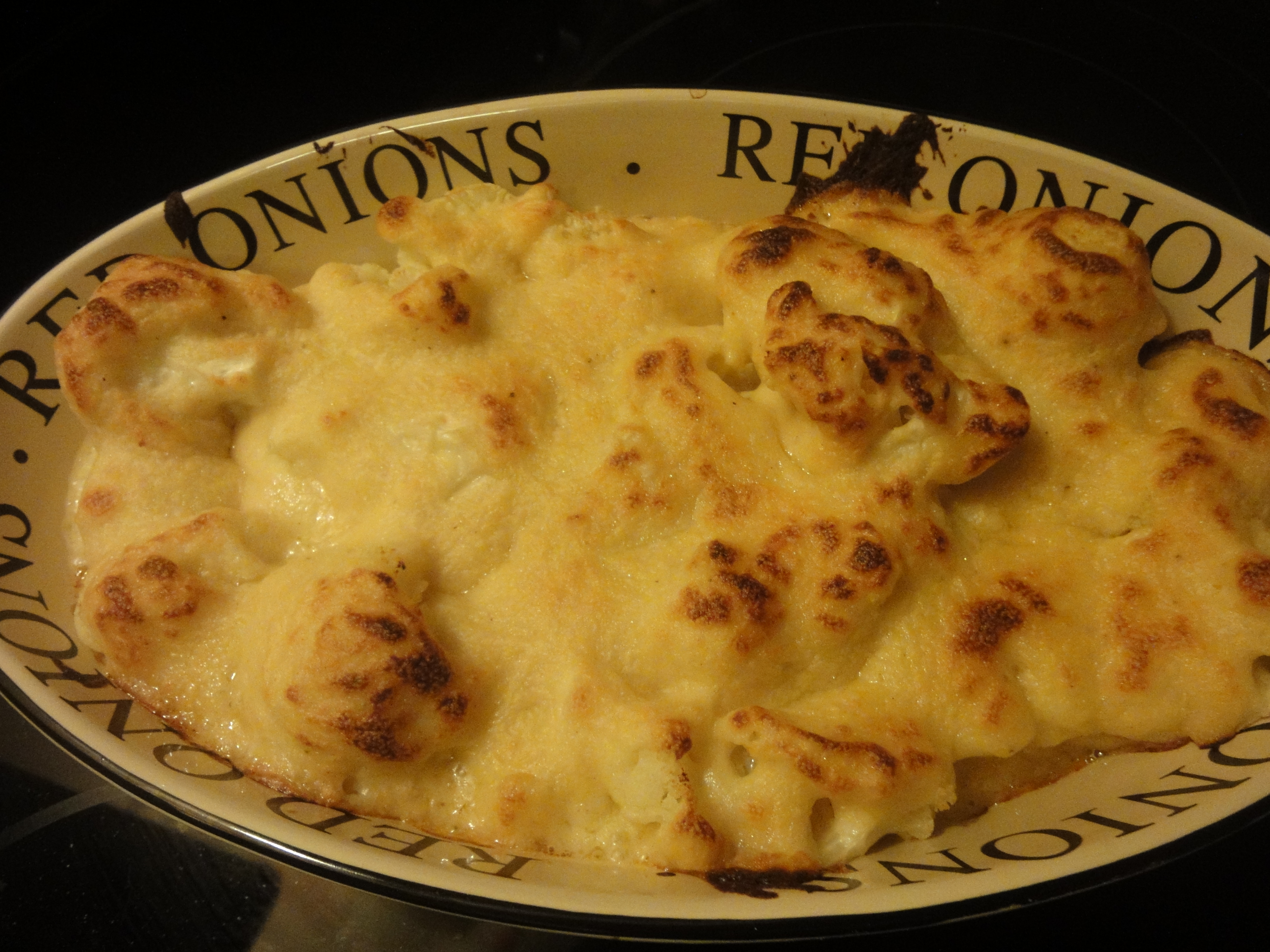
Mmm ... cauliflower cheese
It was a resounding success! Not only did the sauce turn out exactly the way I wanted, but the cauliflower was cooked just enough to be bitesome, not mushy. Bravo, Nigella! You’ve made a believer out of me.
Cauliflower Cheese
1 large head of cauliflower
2 bay leaves
1 stick of butter
2 teaspoons English mustard
1/3 cup all-purpose flour
2 cups milk
3 cups strong cheddar, grated, plus 1/2 cup for sprinkling on the top
Cut the cauliflower into small florets and and put in a saucepan with cold water and bay leaves. Sprinkle with salt. Bring to a boil, then drain and then refresh with cold water. Let the water drain in a colander. Then put the cauliflower in an even layer in an ovenproof dish.
Preheat your oven to 425 degrees. To make the cheese sauce, melt the butter in a saucepan and then whisk in flour and mustard, and cook over a gentle heat for 5 minutes. Whisk in the milk off of the heat, and then put it back on the heat and keep stirring until it becomes thick and begins to bubble.
Sprinkle in the 3 cups grated cheese and stir over heat until it has melted into the sauce. Pour the sauce over the cauliflower in the dish, and scatter remaining cheese over the top. Cook for 20 minutes or until the cauliflower is hot and bubbly and the cheese has browned slightly on the top.
Does my butt look greedy in this?

Gordon Gekko has never been to a Hometown Buffet.
Greed is good. Gordon Gekko’s famous line from Wall Street still rings true in restaurants across the US.
When I first lived in the UK, I was struck by the concept of greed as it relates to food. I was at a Christmas party and the host had set out a delicious spread of food so guests could help themselves, buffet-style. A British woman in front of me commented on how greedy she was for trying a little of everything. Her plate was modest. She was slim. But still, this concept of greed overwhelmed her – or at least commonplace decency welled up, enough for her to make that comment.
Over the years, I’ve heard these kinds of comments over and over by Brits. Most Americans simply aren’t programmed to think this way. We think of greed in terms of money and possessions, but not in terms of eating too much or supersizing our meals. Gluttony may have been one of the seven deadly sins, but the message seems to have evaded our collective conscience.
I challenge you to visit any all-you-can-eat American restaurant like Golden Corral or Hometown Buffet in search of this distinctly British mentality. I can already guarantee there will be no such modesty and no apologies, aside from “I’m sorry that I couldn’t have made room for that second piece of cobbler” or “I’m sorry I didn’t wear my fat pants tonight” variety.
The Britishism Invasion
So, we might be to blame for the fact that Americanisms like “my bad” and “you do the math” has entered the British lexicon, but Slate writer Ben Yagoda has been chronicling the Britspeak, or what he has coined Britishisms, that have been showing up on our sandy shores.
Here are just a few examples:
Advert (instead of advertisement or ad), bespoke, bits (instead of parts), brilliant, called (instead of named), chat show, chat up, cheers, a coffee, cookery, DIY, early days, fishmonger, full stop (instead of period, as in the punctuation mark), ginger (a red-haired person), gobsmacked, had got (instead of gotten), Hoover (as a verb), in future, keen on, kerfuffle, mobile (as in mobile phone), on holiday, one-off, posh, presenter (a television host), queue, sell-by date, shite, short-listed, snog (passionately kiss), sort out, spot on, starter (instead of appetizer), straight away, take a decision, top up, twee, wait for it, wanker, and whilst.
And you can read more in this week’s Slate article.
A special thanks to @RichAppy who tweeted me this story.
Lohs Angeleez
Last night, we watched the series premiere of The X-Factor, which spotlighted auditions in Los Angeles.
Or should I say Lohs Angeleez? Because that’s what host Steve Jones, as well as British judges Simon Cowell and Cheryl Cole were calling it repeatedly. LohsAngeleezLohsAngeleezLohsAngeleez.

An aerial view of downtown Lohs Angeleez. Photo credit: Marshall Astor.
But why? What’s wrong with Lahs Anjuhles? Or at least the original Spanish Lohs Annhelles?
I don’t think it’s a turn of phrase that is difficult to say with a British accent so I have to wonder … How do these sorts of national mispronunciations get started? Is there a British pronunciation handbook somewhere that decides these sorts of things? Is it written by the Queen? And can I buy it on Amazon?
You say tomato, I say tomahto
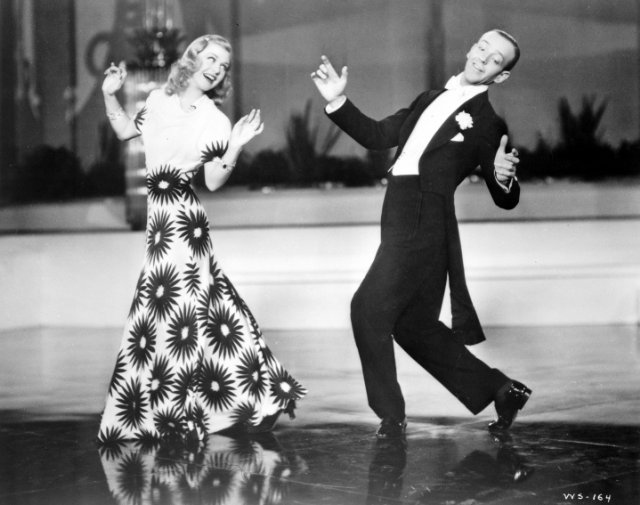
In 1937, George and Ira Gershwin’s song “Let’s Call the Whole Thing Off” was featured in a film called “Shall We Dance” with Fred Astaire and Ginger Rogers. It was apparently part of a dance number done on roller skates.
I haven’t seen the movie but I love the song. Correction – we love the song and over the years, Matthew and I have come up with quite a medley of verses as we have discovered the slight differences in pronunciation between British English and American English. Our song goes something like this …
You say scheduled, I say sheduled,
You say oREGano, I say oreGAHno,
Scheduled, sheduled
oREGano, oreGAHno,
Let’s call the whole thing off.
You say aluminum, I say aluminium,
You say mom, I say mum,
Aluminum, aluminium,
Mom, mum,
Let’s call the whole thing off.
You say wahter, I say wohtah,
You say BAYsil, I say BAAAzil,
Wahter, wohtah,
BAYsil, BAAAzil,
Let’s call the whole thing off.
You say garAHj, I say gare-edge,
You say airplane, I say aeroplane,
GarAHj, GARE-edge
Airplane, aeroplane,
Let’s call the whole thing off.
We can sing like this for quite a while. Can you add a verse?
Affectionate Anglos

If you’ve watched too many episodes of Masterpiece Theatre, you might get the impression that the British are all standoffish and Mr. Darcyish, with their top hats and stiff upper lips.
Not so.
Actually, I’m routinely taken aback by how very affectionate Brits are. They’re always greeting people with a kiss on the cheek, even those they might meet for the first time. That doesn’t happen in America.
And they’re always ending letters and emails with kisses (x = kiss, if you didn’t know). Sometimes two = xx. Oftentimes three = xxx. And even as much as four = xxxx. I’m not talking about schoolchildren. I’m talking about full-fledged adults. This is the way they sign off every letter. It’s downright romantic!
But what about hugs, I hear you asking … Well, what about them?! Brits can hug as well as the next Yank. Check out the new Hug London Facebook page that’s formed post-riots to heal the city. Hosted by Maggie’s Cancer Caring Centers, the community page invites anyone to send in photos of themselves hugging London landmarks. They will be gathering at 12:30 p.m. tomorrow to hug City Hall in London. So much for the stiff upper lip …


 BRITRISH.COM