Blog Archives
Mince pie love
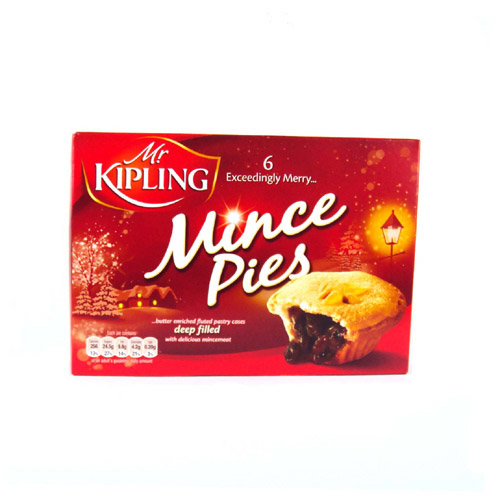
It’s nearly Christmas Day and in the frenzied rush up to Christmas, I’ve still not had one mince pie.
I was quite vocal about my dislike for the dried-fruit disaster better known as Christmas pudding, but mince pies takes some of the same elements, pairs them with pie dough and becomes magic.
I’m partial to the “exceedingly good” Mr. Kipling mince pies, available at Cost Plus, heated and eaten a la mode (but that’s an American thing. I don’t believe any self-respecting Brit would put ice cream on pie. Dessert is always served with cream).
Better yet, screw the warm pie crust top off (like a little hat), put a dollop of cream on it and then put the pie hat back on, before biting into the sheer bliss of Christmas. You’re welcome, America.
Boogers, bogies, and the bogey man
 I’m taking a moment to clarify since this is a confusing matter:
Boogers [boog-er] : a piece of dried mucus in or from the nose.
Bogies [boh-gee] : British. a piece of dried mucus in or from the nose.
Bogey man [boog-ee-man, boh-gee-, boo-] : An imaginary evil character of supernatural powers, who may or may not have boogers or bogies in his nose, especially a mythical hobgoblin supposed to carry off naughty children, who may or may not have boogers or bogies in their noses.
Questions? Bueller? Bueller?
Trail blazers
I know. I’ve blogged before about J. Crew, but hot damn! I’m loving their fall collection.
Have you seen their women’s blazers this season? So preppy and British and fall-like. Check out their schoolboy blazer in Donegal tweed.

Or their schoolboy blazer in Prince of Wales wool tweed …

Or their Hacking Jacket in tweed, sourced from the famed Robert Noble mill in Peebles, Scotland, which has been producing woolen products since 1666.

They make me want to slap on a pair of riding boots and head out into pony country. Tally ho!
Guide to understanding the British
If you know a Brit, this handy dandy Anglo translation guide might come in handy (and uh, be dandy). Not sure where this originated, but I love it.

New money
Today the Bank of England has begun circulation of a brand spanking new £50 banknote. Behold!

I’ve previously discussed the beauty of British money. The latest banknote features the portraits of Matthew Boulton and James Watt, inventors of the steam engine, which later led to the manufacturing of coins that were difficult to counterfeit.
Note that this is the first time that two portraits have appeared side by side on the back of a Bank of England banknote. Real history in the making and fodder for future Jeopardy episodes.
Even more impressive is the fancy stuff. Since I’m not in the inner circle to get my mitts on one of the first £50 banknotes, I’ll leave the description to the BBC:
“The new version of the £50 banknote has a thread woven into the paper, rather than printed on it.
There are images on the thread of a £ symbol and the number 50 which move up and down when the banknote is tilted from side to side.
When the note is tilted up and down, the images move from side to side and the symbols switch.”
What??!! Numbers moving up and down?! Images moving side to side?! Symbols switching?! Is this currency or something courtesy of David Blane?! Why can’t the US put this kind of thing together? Oh US Treasury, I know you’ve got a lot on your plate, but please step up your game.
Red light, green light (oh, and amber light)
In addition to baking up a storm this weekend, I also completed online traffic school.
(You may remember that I was smacked down with not one, but two red light traffic camera tickets a couple of months ago – a proverbial embarrassment of riches after years of a near-perfect driving record.)
Well, this weekend I was eyeballs-deep in the rules of the road. Among other things, I refamiliarized myself with the red, yellow and green light. Or rather, the red, amber and green light, if you’re a Brit.
Red, amber and green? Yes! Is there anything more poetic than to call your basic yellow light “amber”? And why stop there? They should go with crimson, amber and moss? Or candy apple, amber and emerald? Why not?!
And that’s not the only difference between UK and US traffic lights.
* American lights go red to green to yellow, then back to red.

* British lights are more complex. They go red to red and amber at the same time, to green to amber, then back to red again.

I have heard that the US used to have this kind of sequence back in the 1950s and that you can still spot this in some parts of rural America but I have yet to see a yellow light follow a green light. Have you?
Oh, those pesky fine china drying woes!
 I have a love/hate relationship with tea towels. I love how they look and feel, but hate how semi-unabsorbant they are. Pretty? Yes. Functional? Well, they’d lose to a Bounty Quicker Picker-Upper every time.
But in researching the history of tea towels (oh, the things I do for you, dear reader), I’ve discovered that that is an unfair comparison to make. Tea towels were never intended to be used as a replacement kitchen towel to dry saucepans and colanders. Tea towels were created in 18th Century England as a towel to dry expensive tea service pieces of china. Hence, its name and the use of linen material so it wouldn’t scratch these fine pieces.
Fast forward to modern America and so many of us use tea towels as regular kitchen towels because, well, we have them around, we don’t exactly have fine
china and they are towels, aren’t they? I suspect we’ll continue to see an increase of tea towels in American homes as the tea towel industry continues to roll out sweet and sassy designs that make buying tea towels an easy sell. Even for those of us who have no business drying fine china.
In that spirit, check out some of these British-themed tea towels from ToDryFor.com.
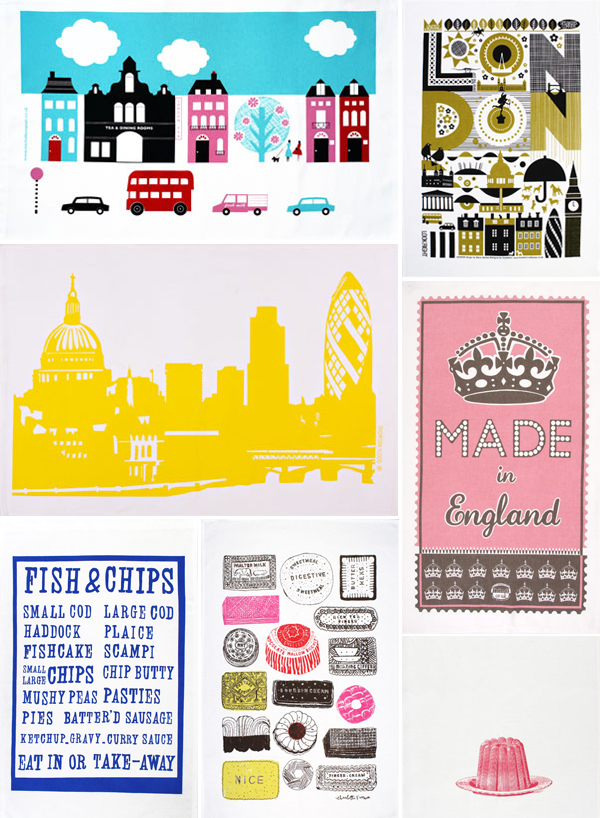
Shown above, starting at the top left and moving clockwise: London Calling, London, Made in England, Jelly, Family Favourites, Fish & Chips and City Skyline. All are available at ToDryFor.com, which delivers in the US.
Make mine a (British) pint
 I used to think that measurements were standard. An inch is an inch. A cup is a cup. No matter where you are in the world, right?
Well, apparently not.
Order a pint at the pub in the UK and you’ll get 20 ounces. Order a pint in the US and you’ll get a mere 16 ounces. Yes, a British pint is about 20% bigger than an American one.
This is usually the point when Brits can rightly beat their chests and guffaw at Americans with their tiny pints and their extra-cold lager and their “American football” played with all of that padding (sorry, that has nothing to do with beer. I just felt like throwing that in).
But here’s the science: Pints are units of measurements in something called US customary units as well as the imperial system, which is what the UK uses. And so, although they have the same name, they are two different animals.
Even more fascinating is this little tidbit, courtesy of Wikipedia: “A ‘pint’ of beer served in a tavern outside Great Britain and the United States may be a British pint, an American pint, or something different, depending on local laws and customs.”
The moral of this tale? If you must choose between a pint in the UK or the US, go with the British pint and choose some real ale, while you’re at it!
The Controller with Weight Issues
I’m always a little fascinated when American publishers take a perfectly good UK book and dumb it down for American audiences.
For example, the first Harry Potter book, Harry Potter and the Philosopher’s Stone, was renamed Harry Potter and the Sorcerer’s Stone in the US because the dumbledores at Scholastic didn’t think American kids would want to read a book with the word “philosopher” in the title. Sad.
Ditto with Thomas the Tank Engine which had to be renamed Thomas the Train in the US because heaven forbid, we make anything slightly complicated for American children. What did they think? We would confuse Thomas who looks, sounds and acts like a train with a car engine?
But some of these American publishers’ changes are just pure political correctness at their best. My favorite remains … this guy.

If you’re from the UK, you know him best as the Fat Controller. Because he is the train director, and, well, he’s fat. Simple. How much of a backstory do we need to give these characters? It’s not actually until you’re much deeper into the series that it’s revealed that his name is Sir Topham Hatt.
Now if you’re from the US, you know him only as Sir Topham Hatt. Not as The Fat Controller. (I imagine at some point they probably debated calling him The Horizontally Gifted Controller or the Metabolically Challenged Controller before settling on Topham Hatt.) The same is true for the character of The Thin Controller. He is only named Mr. Percival in the US. (Not the Horizontally Challenged Controller.)
And that’s fine. They can call them whatever they want. But in my house? We’re reading the British versions.
Singing with an accent
 On Sunday morning, I stopped into a Starbucks for my morning coffee and ended up in line behind a middle-aged couple, who were trying to decide whether to buy a copy of Hugh Laurie’s latest blues CD on display.
After a moment of consideration, the barista said, “Have you heard anything from his album? It’s really very good. It has some great piano and he has a good voice. You can’t even tell that he has an accent.”
One moment later, the man handed it to the barista and said, “I’ll take it.”
This whole interaction was fascinating to me for a couple of reasons.
1) I have never seen anyone buy a CD at Starbucks. I’ve never even seen anyone ever pick up a CD featured at Starbucks to take a closer look. Have you? And for this man to purchase this CD, without ever hearing any of it? Truly a leap of faith.
2) I am fascinated that the barista felt compelled to say that Hugh Laurie sings without an accent. It’s a strange selling point. Is music more or less likable when sung with or without an accent? Does anyone really care?
I’ll admit that the ability to sing without an accent is an unusual talent. I’m not quite sure how it works. But I can only imagine it’s like the natural inclination I have when I hear a country song and feel the need to sing to it with the worst hillbilly accent that I can muster. Maybe that’s how Hugh Laurie feels when he sings the blues. Sometimes songs just sound better or feel better with an accent (even if it’s not your own).
But I’m sure part of this homogeny of accent-less music these days is a calculated move by studio execs to make music more palatable to an American audience.
And to that, I say calculated commercialism, be damned. I like hearing an accent in my music. I like the way the Proclaimers sound when they go all Scottish on “500 Miles”. I like hearing Herman’s Hermits singing about how Mrs. Brown has a lovely dah’er. And I like hearing the Arctic Monkeys’ Fake Tales of San Francisco, when I can already tell they’re not from there.
Am I the only one? How do you feel about hearing accents in music?


 BRITRISH.COM